
Weightlessness aboard a rotating space station.
Still from 2001: A Space Odyssey (1968), directed by Stanley Kubrick.
How stretch performance fabrics respond to low-gravity environments: drape mechanics, seam tension, kinetic expression.
October 2025
Weightlessness aboard a rotating space station.
Still from 2001: A Space Odyssey (1968), directed by Stanley Kubrick.
Every drape coefficient, every bias cut, every principle taught in a patternmaking studio assumes a constant: 9.8 meters per second squared pulling downward. Gravity is the invisible co-author of every silhouette ever made. The shoulder seam works because gravity pulls fabric from that shelf of bone. The A-line skirt works because gravity fans the hem from the hip. Remove that force and the garment doesn't simply float. It becomes a fundamentally different object.
I've been working from this premise since 2023, when I started developing Arise as my MFA thesis collection at the Fashion Institute of Technology. That premise carried into Rhododendrons, tested aboard a parabolic zero-gravity flight in 2024, and it continues to drive my current work. Conversations with aerospace engineers, space-fashion scholars, and spacesuit designers sharpened the question from a poetic one into a structural one: if gravity is removed from the system, what holds a garment together, and what does it become?
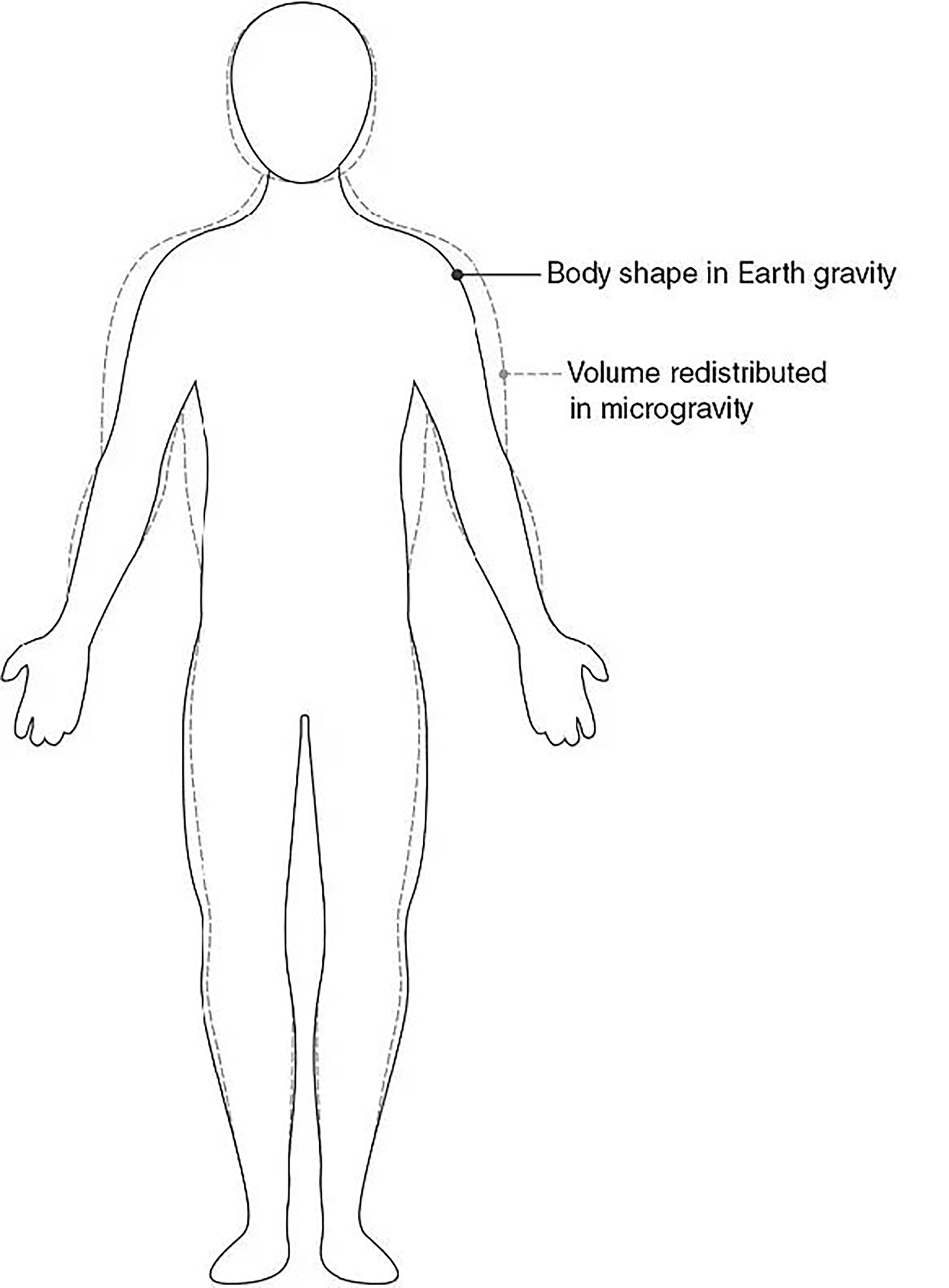
Body volume redistribution in microgravity: the spine elongates, fluid shifts upward, and the neutral posture reshapes the silhouette.
From Barbara Brownie, Spacewear: Weightlessness and the Final Frontier of Fashion (Bloomsbury Visual Arts, 2019).
Zero gravity doesn't simply free the garment from the body. It frees the body from itself.
In weightlessness the body relaxes into what physiologists call the neutral body posture: head tilted forward, arms floating slightly bent, knees gently flexed, hips sloped. It looks like a snowboarder in midair. This is not the anatomical position of a dressmaker's dummy. It's the body's actual resting state once you remove the muscular effort of standing upright.
The fit consequences are immediate. Shirt hems ride up at the back, collars float toward the chin, waistbands gape behind and press at the front. And then the body itself changes shape: fluid redistributes upward, broadening the chest and shoulders. The spine, relieved of compression, elongates by two to three inches. Over longer durations, leg muscles atrophy. The person wearing your garment is not the same shape they were when you measured them.
Nikolay Moiseev, spacesuit designer at Paragon Space Development Corporation, described the movement pattern to me: astronauts don't walk. They use their hands to move. Feet trail behind, vestigial. The center of physical activity shifts entirely to the upper body. A garment designed for zero gravity has to accommodate a body that is taller, broader in the chest, slimmer in the legs, and moving primarily through its arms and shoulders.

Fabric suspended underwater: without gravity's downward pull, drape disappears and the textile tents around the body.
Photograph by Ric Frazier.
Drape, as the industry defines it, is a product of gravity acting on fabric from a point of support. The shoulder, the hip, the bust: shelves from which fabric hangs. In zero gravity those shelves disappear and drape ceases to exist.
Barbara Brownie, author of Spacewear: Weightlessness and the Final Frontier of Fashion, describes the shift precisely: in a weightless environment the garment contains the body but is not supported by it. A polo shirt on the International Space Station doesn't rest on the torso. It surrounds it like a soft tent.
One of the most important things I learned from my research conversations with Brownie: loose fabric in zero gravity is flatter than you'd expect. It doesn't billow the way wind makes fabric billow. Wind adds resistance and inertia. Zero gravity removes resistance entirely. Fan tests and trampoline tests, the closest Earth-based simulations, don't fully replicate the real behavior. The fabric doesn't sail. It tents.
This inverts conventional textile selection. Lightweight fabrics, which on Earth skim or cling beautifully, become the most unpredictable in microgravity, pushed around by the smallest air currents. Heavier fabrics are actually more controllable, their mass providing enough inertia to hold a shape once set in motion. In Earth fashion, gravity holds the garment to the body at natural contact points. In microgravity there are no natural contact points. Any contact has to be engineered through elasticity, tethering, or close fit.
"The fabric does not sail. It tents."
For Arise fittings, I borrowed the centrifugal air circulation technique devised by one of my favorite artists, Daniel Wurtzel.
Personal draping experiments.
This leads to maybe the most unexpected dimension of the problem, which is the psychological one.
When garments float away from the body, the wearer may feel exposed, not because they look naked but because nothing is touching their skin. Brownie drew a sharp distinction from swimming: in water, even when wearing less, the water itself maintains constant contact. In space, if the garment lifts away, there is nothing. Astronauts have reported losing awareness of where the body ends and the environment begins.
So contact points in a zero-gravity garment aren't only structural. They're psychological. This became foundational to my work: the base layer has to touch the skin. Whatever floats and transforms in weightlessness, the foundation maintains intimacy between garment and body.
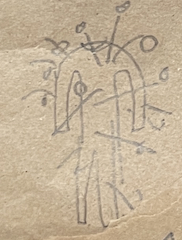
Early concept sketch for Arise: tethered panels radiating from the body like a kite held at its anchor.
Deborah Won.
The system that resolved these tensions came from kites, the oldest human aerial device. A kite holds its shape not through internal structure but through tension between a tethered anchor and the forces acting on its surface.
Arise borrowed this logic for small ornamental blossoms tethered to the body at single points. In one gravity each blossom was held closed. In zero gravity it opened. Gravity had been keeping something hidden and its absence revealed it.
The next evolution extends that logic to the garment itself: a fitted base layer built for full-range zero-gravity movement, with tiered gathered panels attached at precise intervals, each sewn at one anchor seam. The hem of each tier is dense, soft fringe. In one gravity the tiers stack downward and the fringe is concealed. In zero gravity every tier lifts, every fringe filament floats free, and the body at the center becomes the structural frame, orbited by its own construction. The garment is the kite, the body is the anchor, and space is the wind.
This isn't metaphor. The tether seam is load-bearing in both states: holding the tier in place under gravity, defining the radius of its float in weightlessness. The fringe, deliberately dense, gives each tier enough mass to float coherently rather than drifting at random.
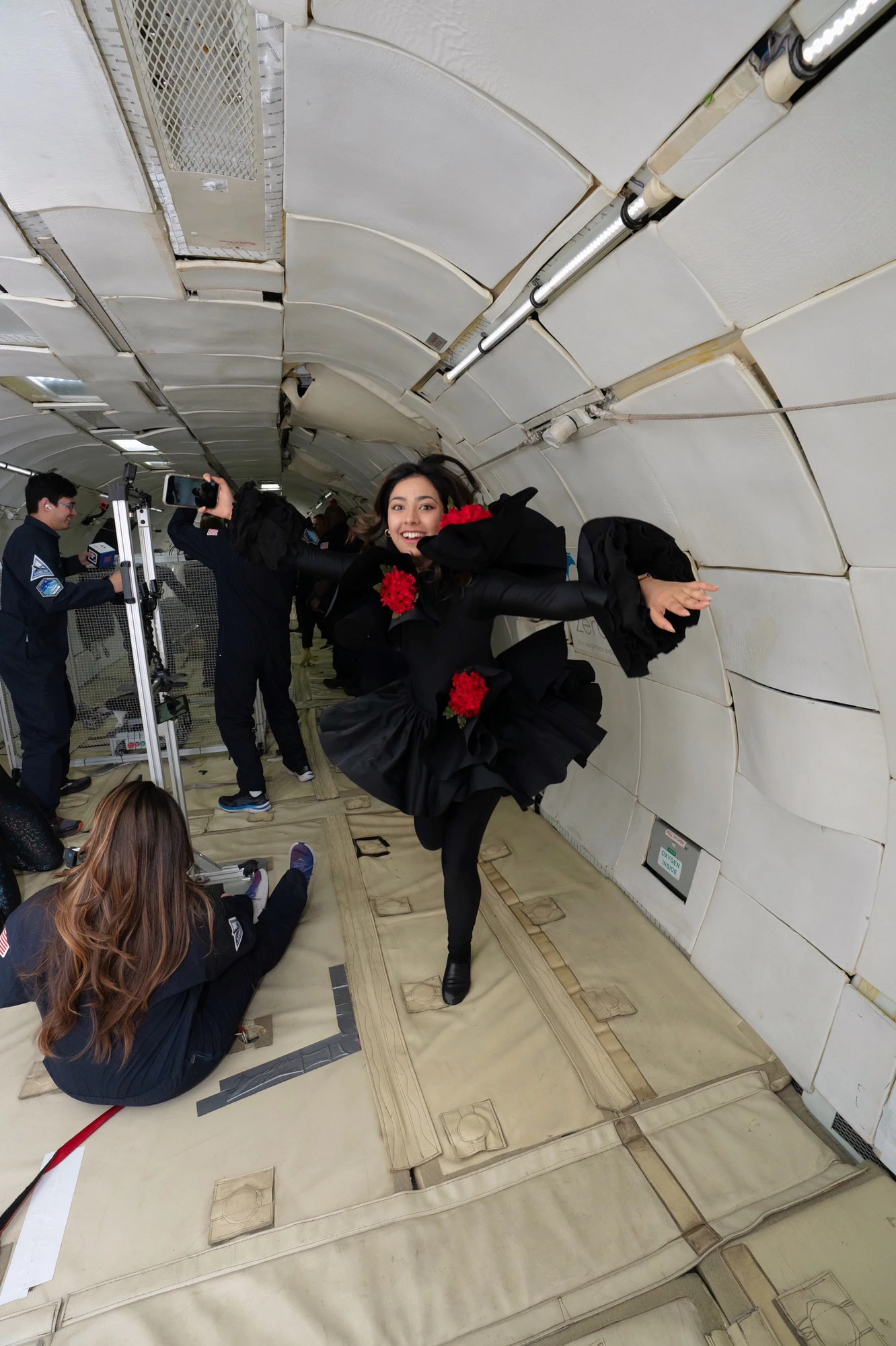
The transformation moment: red silk flowers blossom as gravity disappears during a parabolic arc.
Design: Deborah Won. Wearer: Jagriti Luitel. Flight partner: Aurelia Institute (Horizon 2024). Operator: Zero-G.
The insight that reshaped this work came from Brownie: the transition between gravity states is the design opportunity, not the static zero-gravity state.
Every artist and scientist who has worked on parabolic flights confirms this. The spectacle is the crossing, the moment the garment begins to change. Dr. Alexis Hope of the MIT Space Exploration Initiative framed it another way: this is garment as experience, not garment as performance. You're dressing for an encounter with yourself.
Rhododendrons proved it. As part of the Horizon 2024 Cohort the garment was worn aboard a parabolic flight. Red silk flowers, individually formed and heat-set, were attached at calibrated distribution points across a fitted bodysuit. When gravity disappeared the flowers blossomed. The ruffles expanded. The garment became visible evidence of the gravitational state of the environment. The wearer, Jagriti, requested one modification during construction: a pocket for her phone. She wanted to capture her own transformation.
During the thesis fitting process, models jumping from trampolines confirmed it physically: the transforming ornaments were felt before they were seen. The elation was haptic before it was visual. That's something no sketch or rendering can predict.
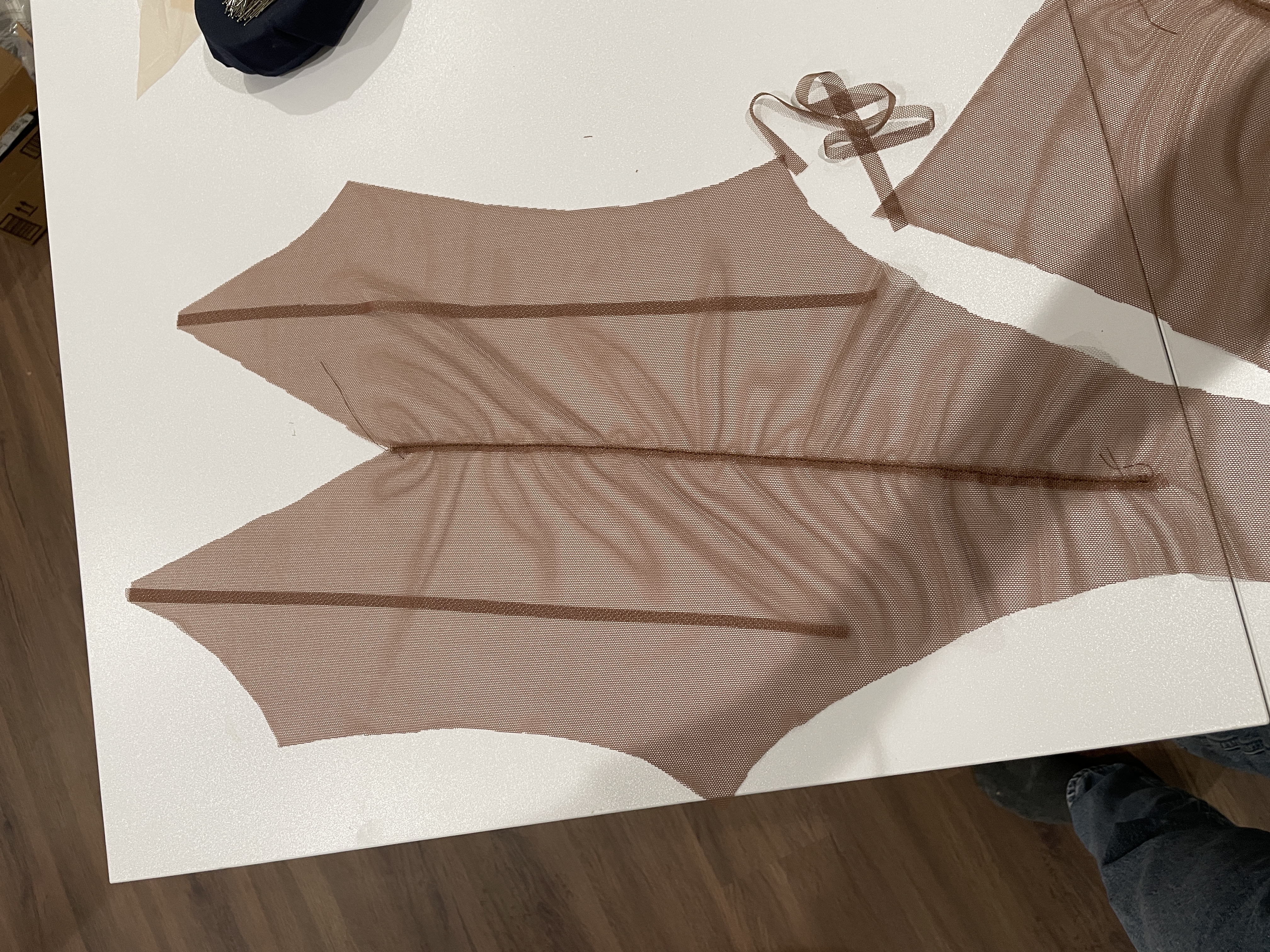
Bodysuit development for Arise: every tether seam must hold under 1.8g ascent and define the panel's drift radius in weightlessness.
Deborah Won.
A technical note for anyone thinking about construction in variable gravity: seam tension behaves differently across gravity states, and this matters more than you'd think.
In one gravity a tether seam bears a predictable downward load. In zero gravity the load vanishes, but the seam becomes the defining geometry of the panel's movement, determining how far each tier can drift. During ascent, when hypergravity reaches 1.8g, that same seam bears nearly double its Earth load. The garment becomes heavier and more structured than it ever is on the ground.
Suborbital flights offer roughly five minutes of weightlessness. The garment spends more time in variable gravity than in zero gravity, so it has to perform across the full spectrum. You're not designing for one condition. You're designing for all of them at once.
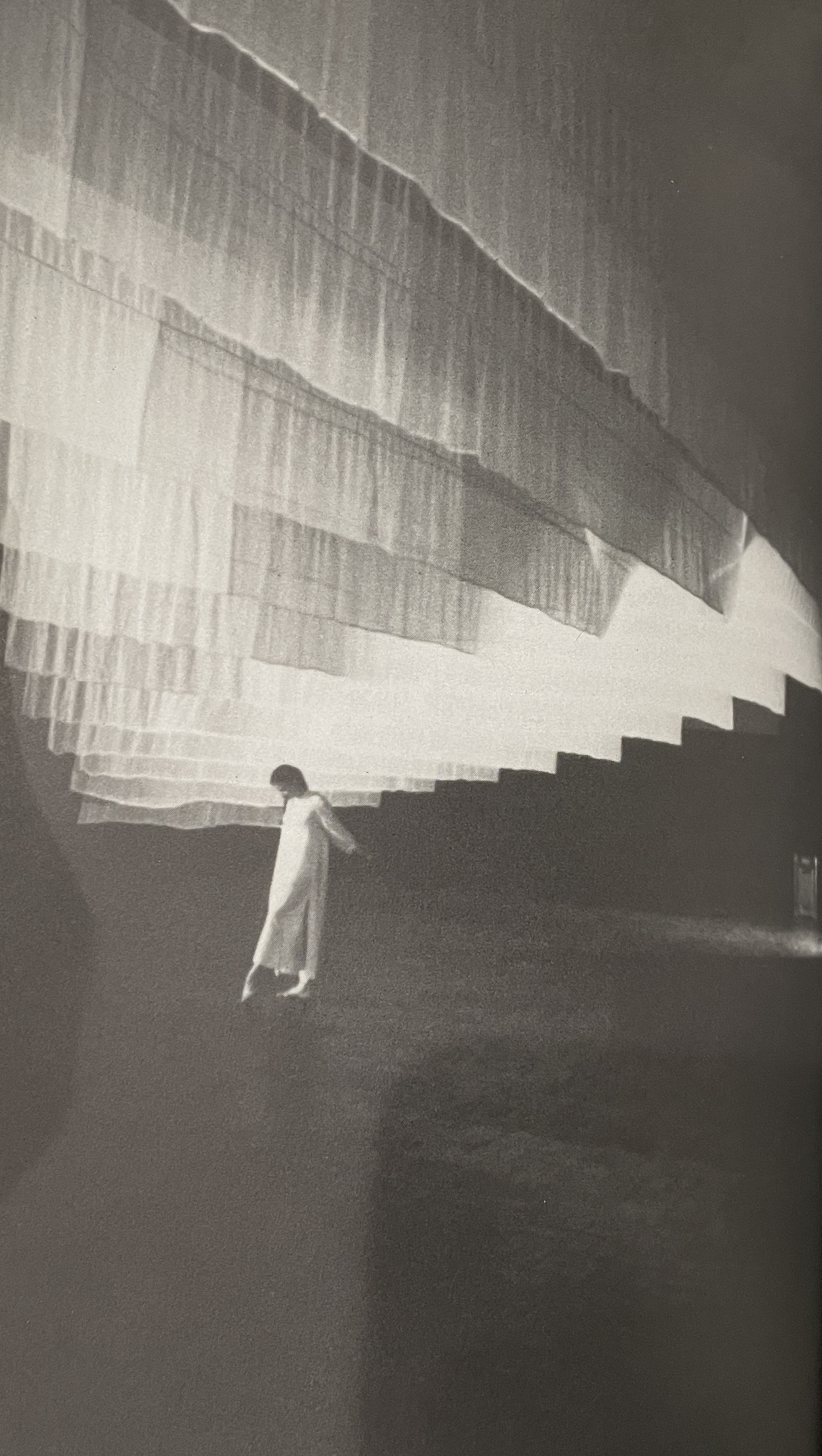
Fabric held aloft by tension and air: the oldest principle behind the kite, and behind this work.
Tal Streeter, Breath Clouds for Friends Who Have Disappeared. From Art That Flies by Pamela Houk.
I don't yet know how dense fringe behaves over durations longer than the eighteen-second arcs of a parabolic flight. I don't know whether tethered tiers fold gracefully or chaotically when gravity returns. I don't know whether the blossoming remains an event on the hundredth repetition.
What I do know is that the physics are specific and the construction logic works. The kite principle, the tethered base, the fringe as mass-calibrated ornament, the transition as the design event: these are engineering decisions that produce a measurable, visible transformation. The rest is testing.
The question that started all of this, watching footage of a cosmonaut's knit shirt floating aboard Mir, still holds: what does a future space traveler want to wear? Not the geometry of the Space Age. Something that responds to the body's actual experience of weightlessness. Something that transforms. Something that blossoms.
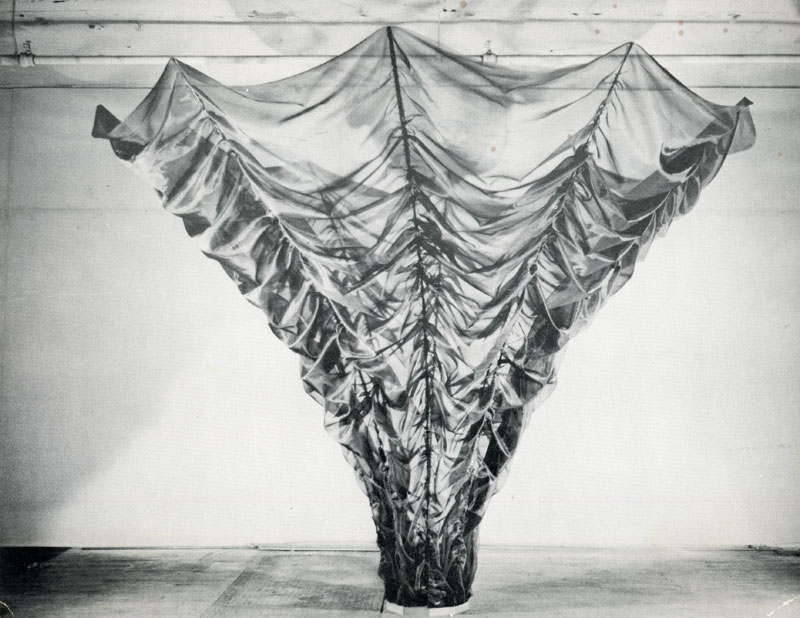
Fabric as architecture, suspended without gravity's cooperation.
Anne Healy, Sculpture, A.I.R. Gallery, 1973.
Interested in my work?
Leave your email to hear about new projects, exhibitions, publications, and occasional laboratory updates.
You're in.