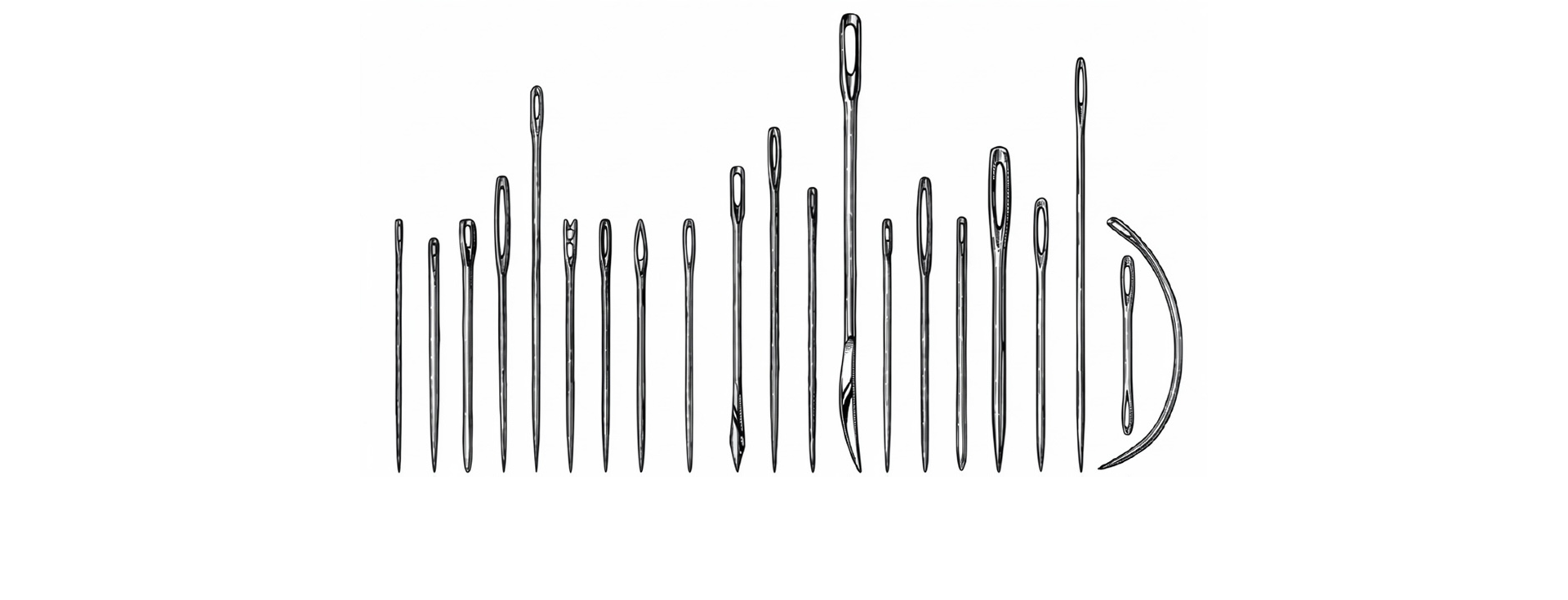
Illustration of sewing needles arranged by size, showing the variety of needle types and systems used in garment construction
Tool

BOM Prep

Quick-reference tool for pairing the right needle system to each machine without searching manuals.

May 2026

Do you switch between a lot of sewing machines? Do they all use different needle systems? Do you use a variety of thread weights and materials and construction techniques? As a one-person brand, I spend way too much time on inventory when I want to be spending more time on designing and execution. So I vibe coded this little tool in Claude to streamline which machine does what part of the process and what notions I need based on my garment type and my fabric weight. I put in as much information as I have on hand on the left panel, and BOM Prep generates a PDF that tells me which machine I should be using and what supplies I need.


It's not an end-all be-all, but it works pretty well for my specific needs. You can download the markdown file below, which will enable you to tailor a copy of it to your own needs. Have your machine manuals ready in PDF form, as that will determine the proper recommendations. Have fun.
Skip to the download

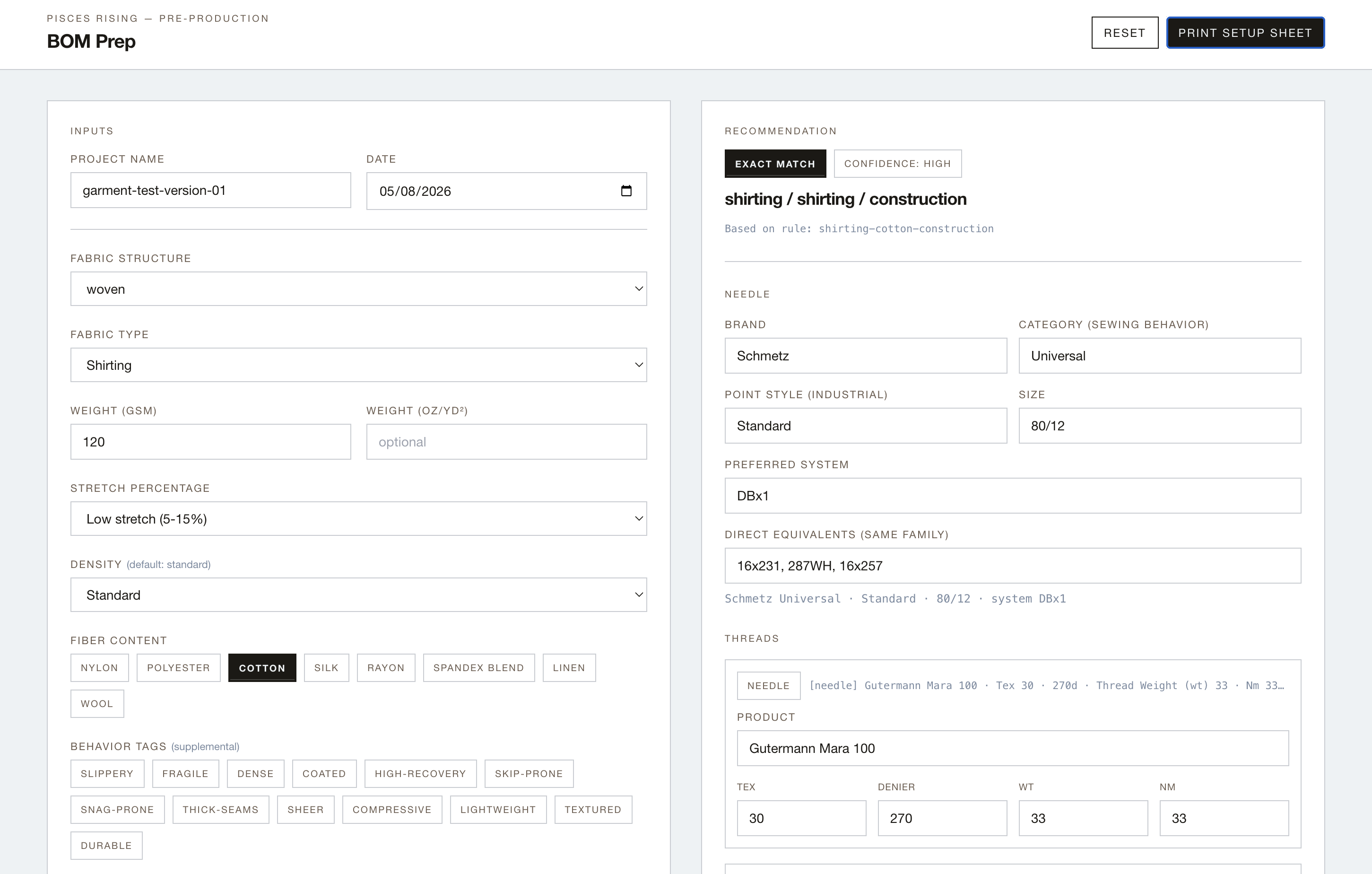
A fabric structure selected from a dropdown. Woven. A type: Shirting. The interface populates: 120 GSM, low stretch, standard density, cotton. Then a recommendation appears on the right. Needle: Schmetz Universal, Standard 80/12, preferred system DBx1 with direct equivalents in 16x231, 287WH, 16x257. Thread: Gutermann Mara 100, Tex 30, 270 denier, 33 wt, Nm 33, needle and bobbin both. Stitch settings, machine compatibility, confidence level. The whole output reads like a setup sheet you'd pin inside a sample room binder.


That's BOM Prep. It takes what you know about your fabric and your operation and gives you back a complete, printable sewing setup recommendation. No accounts, no backend, no subscription. A local rule engine running in your browser.

BOM Prep showing a completed recommendation for woven Shirting with construction operation, including needle, thread, stitch settings, and machine compatibility

Completed recommendation for woven Shirting, construction operation. The right panel shows needle with preferred system and direct equivalents, thread with full unit conversions, stitch settings, machine compatibility, and confidence level.

The invisible system here is language. Sewing terminology collapses multiple concepts into single words, and every collapsed term produces a bad recommendation if you don't pull them apart.


"Swimwear" isn't a fabric. It's an application. "Stretch" isn't a point geometry. It's a behavior. "Microtex" is simultaneously a marketing category and a geometry implication. "ELx705" isn't just a needle name, it's an entire machine platform ecosystem. You can't build a reliable recommendation engine on vocabulary that's doing this much double duty.


And the units don't help. Fabric is sold in ounces or grams depending on who's supplying it. Thread is labeled in weight, denier, or Tex depending on who's selling it. Needle systems have their own web of conversions, and not every supplier gives you specs in every metric. Now multiply that by every machine you're using in your process, then multiply it again by every project you're running at the same time. The lookup problem scales fast and it scales silently, because each individual decision feels manageable until you realize you've been cross-referencing three different unit systems in your head for an hour.


The system underneath BOM Prep is a separation. Fabric structure, fabric type, garment application, operation type. These are four distinct concepts that sewing vocabulary routinely merges into one word or one assumption. Once they're separated, recommendations become precise instead of approximate. Before they're separated, you're just guessing with confidence.

"You can't build a reliable recommendation engine on vocabulary that's doing this much double duty."

BOM Prep started as a narrow question: what needle do I need for this fabric? That turned out to be deceptively complicated. The answer depends on the fabric structure, the fabric type within that structure, the garment application, the specific sewing operation, and sometimes on construction modifiers like boning or invisible zippers that change the recommendation entirely. No single chart or cheat sheet can hold all of those relationships, because they aren't linear. They branch.


So I built a rule engine. Every recommendation traces to an explicit rule written in human-readable JSON. No machine learning, no probabilistic scoring, no black-box inference. If BOM Prep tells you to use a 90/14 ballpoint with Mara 120 thread, you can open the rule file and read exactly why. Confidence levels are encoded. Failure modes are encoded. Rationale layers are encoded. The logic is visible and debuggable by the person holding the fabric.

BOM Prep workflow: selecting fabric structure, type, application, and operation. The recommendation panel updates as each input is filled.

Thread measurement was the first compatibility problem I had to solve. Thread comes labeled in Tex, denier, weight (wt), Nm, and commercial product names that may or may not correspond to any of those. A single thread can be described five different ways depending on who's selling it and who's buying it. I made Tex the canonical unit. All other measurements are derived from it. That collapsed a massive naming problem into a single reference frame, which means BOM Prep can tell you the same thread in whatever unit system you're used to reading.


The second turning point was distinguishing needle system from machine platform. A DBx1 and an ELx705 might share physical characteristics, but they exist in entirely different machine architectures. The DBx1 is a lockstitch needle. The ELx705 is a coverstitch and overlock needle. You can't swap them, and you can't recommend one without knowing what machine the sewer is sitting at. So BOM Prep models platforms explicitly: lockstitch, overlock, coverstitch, hemstitch, chainstitch. The recommendation engine doesn't just say "use this needle." It says "use this needle on this platform" and flags when a combination is operationally possible but not recommended.


The ontology goes deeper than fabric and needle. It encodes point geometry, substrate density, behavior tags, construction modifiers, rule confidence, failure modes, and rationale layers. It handles things like skipped stitch tendencies on recovery fabrics, differential feed assumptions for knits, seam stability concerns at boning channels, and invisible zipper implications for needle selection. All of this is deterministic. All of it is inspectable. The sewer can look at any recommendation and trace the reasoning back to a set of explicit, human-authored rules.

Thread Unit Tex is canonical. Denier, wt, Nm, and commercial names are all derived conversions displayed alongside it.
Platforms Lockstitch, overlock, coverstitch, hemstitch, chainstitch. Each platform constrains which needle systems and stitch settings are valid.
Confidence Every recommendation carries a confidence level. "Standard match" means the rule was authored for this exact combination. "Edge case" means the system is extrapolating and the sewer should test first.
Failure Modes Encoded per rule. If a fabric-needle combination tends to skip stitches or cause tunneling, the system says so before you start sewing.
Rule Engine Deterministic, no ML. Every output traces to a human-readable JSON rule. The sewer can audit any recommendation.

Sewing knowledge has always been poorly formalized. It lives in machine manuals written decades ago, in production departments where it's passed down by demonstration, in inherited habits that nobody questions because they've always worked well enough, in scattered forum posts where three people give three different answers to the same question, in trade school muscle memory that never gets written down.


Pattern books tried to formalize it. Singer's technical reference library tried. Industrial production departments have internal docs that never leave the building. The knowledge exists but it's distributed, unsystematized, and often contradictory. One source says use a universal needle for knits, another says ballpoint, a third says stretch. They're all partially right, depending on conditions none of them specify.


BOM Prep is an attempt to do what a good sample room already knows but can't export: separate the concepts, make the relationships explicit, and produce a reference that doesn't depend on having the right person in the room. The setup sheet it generates is the kind of document that should exist at the start of every sewing project but almost never does, because building one by hand means holding all of those variables in your head at once.

The problem of collapsing terminology isn't unique to sewing. Wherever practitioners hold tacit knowledge, the vocabulary compresses. In clinical medicine, "chest pain" is an application, not a diagnosis, the same way "swimwear" is an application, not a fabric. The symptom and the condition get fused into one word, and the fusion works fine in conversation but breaks as soon as you try to build a decision system on top of it.


Biological taxonomy solved a version of this problem centuries ago. Before Linnaeus, the same organism could have dozens of names depending on who was describing it and where. The binomial system didn't add new information. It separated concepts the old naming had merged: genus from species, description from classification. The pattern is consistent across domains. Formalization starts by separating what the practitioners' terminology has been collapsing.

BOM Prep outputs a printable industrial sewing setup sheet. One page. Project name, date, operation, application, confidence level across the top. Fabric specs with structure, type, weight, stretch, density, fiber, and layers. Recommended needle with brand, category, point style, size, preferred system, and direct equivalents. Recommended threads with Tex, denier, wt, and Nm for both needle and bobbin. Stitch settings with tension and stitch length. Machine compatibility with platform class and recommendation status. Sewing notes. Test notes section. Final approved setup. Sign line.


It's the kind of thing that could sit in a sample room binder or a production folder without looking out of place. Monochrome. Clean typographic hierarchy. No branding louder than a version number at the bottom. The whole philosophy of the tool is in the output: the recommendations are visible, the reasoning is traceable, and the sewer signs off on the final setup. Nothing runs in the background. Nothing phones home.


The ontology file is open. Download it, adapt it, build on it.

Most sewing "expertise" is untested inheritance. Once the ontology separates the concepts, you start seeing where the inherited knowledge is precise and where it's just habit. The universal needle that "works for everything" turns out to work for a narrow range of conditions. The thread weight that's "fine for most projects" is fine for the projects you've already done, not necessarily the one in front of you.


BOM Prep doesn't simulate certainty. It makes the rules visible so the sewer can decide. When the confidence level says "edge case," that's not a failure. It's the system being honest about the limits of what it knows, which is more than most reference charts will do.


Sewing has always had a formalization problem. BOM Prep doesn't solve it. It makes the problem visible, which turns out to be the harder part.

Deborah Won is a fashion designer and the founder of Pisces Rising. BOM Prep is an ongoing project in sewing ontology and deterministic tooling.

Previous Hemstitching as Surface Language Technique